
Innovation in Interactive Learning
“Getting people out into the real world is also incredibly valuable, but there are a lot of occasions where that’s just not practical. So, we’re having that kind of almost real-world experience, but in a way that is repeatable.”
Have a project proposal to discuss?
Introduction
Anglia Ruskin University (ARU) is a renowned global institution, with students from over 185 countries studying across its four campuses.
Known for its commitment to innovation, ARU was named The Times Higher Education University of the Year in 2023.
Continuing this tradition, recently, ARU launched six new Immersive Spaces at its Cambridge and Chelmsford campuses, along with the eXtended Reality Peterborough (XRP) Innovation and Research Centre.
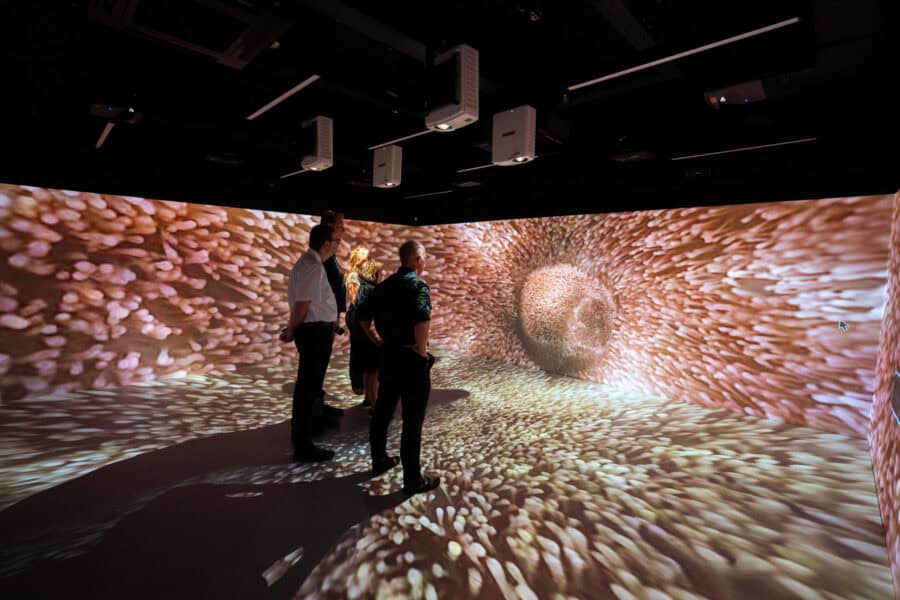
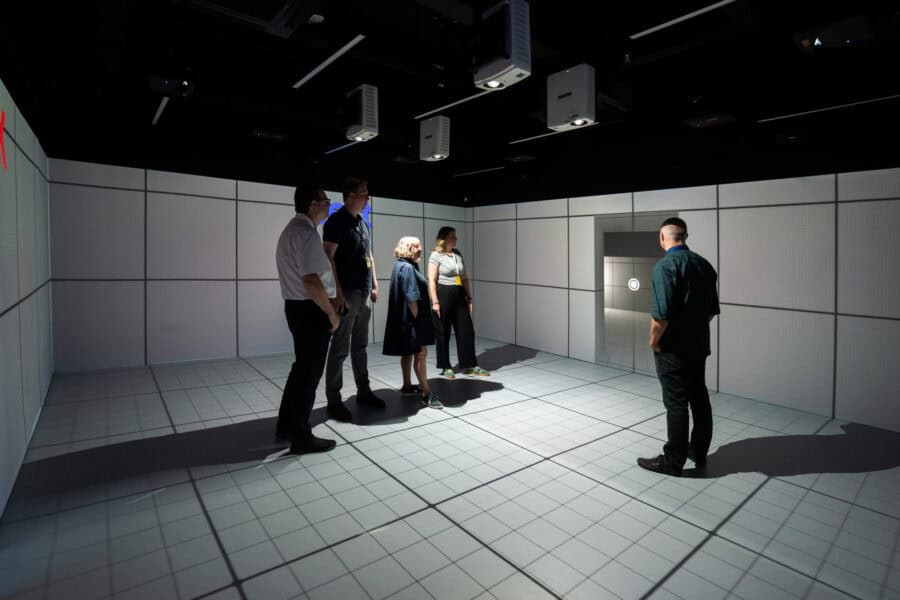
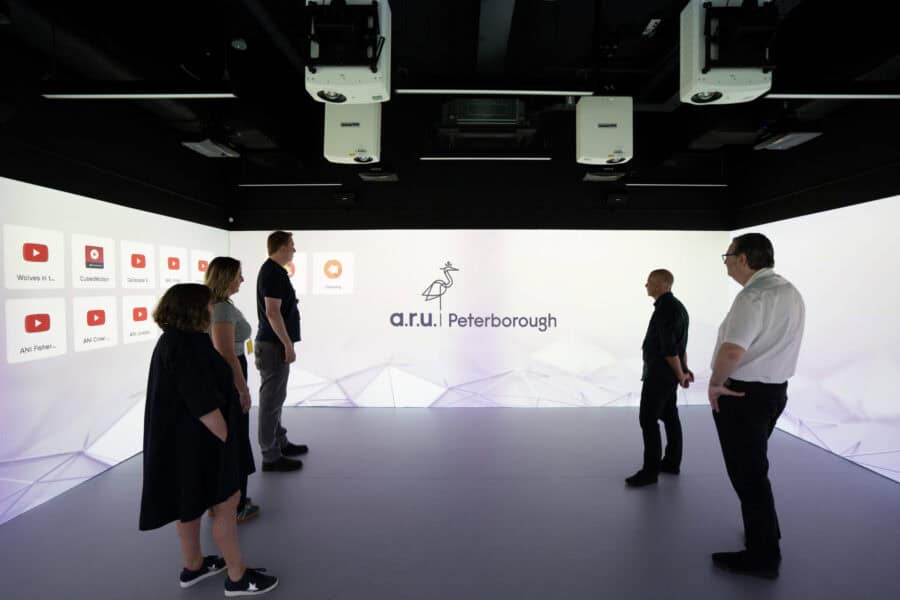
These Igloo spaces provide a shared, immersive experience, much like stepping into a large virtual reality environment, where groups can engage with a wide range of digital content.


The Project
Funded in part by the Office for Students, this project embodies a commitment to innovation.
The immersive experience is achieved using Christie projectors for crisp wall projections, complemented by Digital Projection projectors for the floor. ARU also invested in Igloo’s highest-spec media server, capable of handling demanding content.
Developed in collaboration with Igloo Vision, the spaces are designed for flexibility, allowing them to offer diverse learning experiences across various subjects. This includes a combination of existing 360-degree materials and customised content. Current subject areas identified for bespoke content development include construction, engineering, biology, nursing, midwifery, computing, and gaming.
Many of the customised elements are being created using Unreal Engine, which integrates seamlessly with Igloo’s software platform for immersive environments. An additional advantage of using Igloo’s software is the capability to save individual sessions for each subject area, ensuring flexibility and enabling lessons to be loaded quickly without extensive pre-configuration.
“Having that quick desktop-like experience is really useful for the less technical members of staff who just want to get in and use it. We can just say, click on there to load up your space and then just go with whatever lesson plan you already have.”
Going Forward
As time goes on, experimentation with mixed reality or ‘phygital’ environments (environments that blend both physical and digital elements to create a unified experience) will take place, combining real-life props with digital environments to expand on the learning experience. This will be especially useful for the healthcare provision, as the space allows for large props such as medical dummies to be used.
The university also plans on leveraging some of its existing capabilities to further enhance the shared immersive experience. One way that they plan on increasing the student interaction and immersion is through its motion capture suites, using performance capture to bring more lifelike models into the digital environment.
“Students who have already been in are very, very keen to come back and experience more learning in the space. It will also allow students to be able to critique their own activity by utilising cameras and recording. They’ll be able to see how they react in those environments. They’ll be able to then work through that in one of the adjoining teaching spaces that we have here and reflect on the way in which they behaved. Encouraging that reactive and proactive approach to taking responsibility for learning in those environments will be really important.”
Dr Lucy Jones
Vice Principal, ARU Peterborough
“People’s reactions come into the room for the first time. They’re almost always blown away… We had a family in there the day we opened the room, and we had a 360-video showing a beach, a little bit of tranquil location, gentle music playing, and the tide rolling in and out. There were two children in the family that just went up to the space where the water was rolling in and then they chased the tide out. And as it came back, they ran away from it. It was really cute, and it just showed how they just instantly became immersed and the space felt real to them.”
Jamie Myland
Senior Lecturer Practitioner in Computer Games Technologies